Some spaces are designed to be experienced slowly. Others have to work hard from the moment the doors open.
A hotel lobby welcomes hundreds of guests. An office corridor carries people throughout the working day. A retail floor deals with constant footfall, furniture movement and regular cleaning.
Hospitals, schools, restaurants and public buildings create similar demands. In these environments, flooring is not simply part of the décor. It is part of the infrastructure.
This is where homogeneous full-body tiles become particularly relevant. Designed with consistency through the body of the tile rather than relying only on a decorative surface layer, homogeneous porcelain offers a different approach to flooring- one that puts long-term performance at the centre while still allowing architects and designers to create composed contemporary spaces.
For LANKATILES, this is an important design territory: surfaces created not only for how a space looks on opening day, but for how it needs to perform after years of everyday use.
What exactly is a homogeneous full-body tile?
The easiest way to understand homogeneous tile is to look beyond its surface.
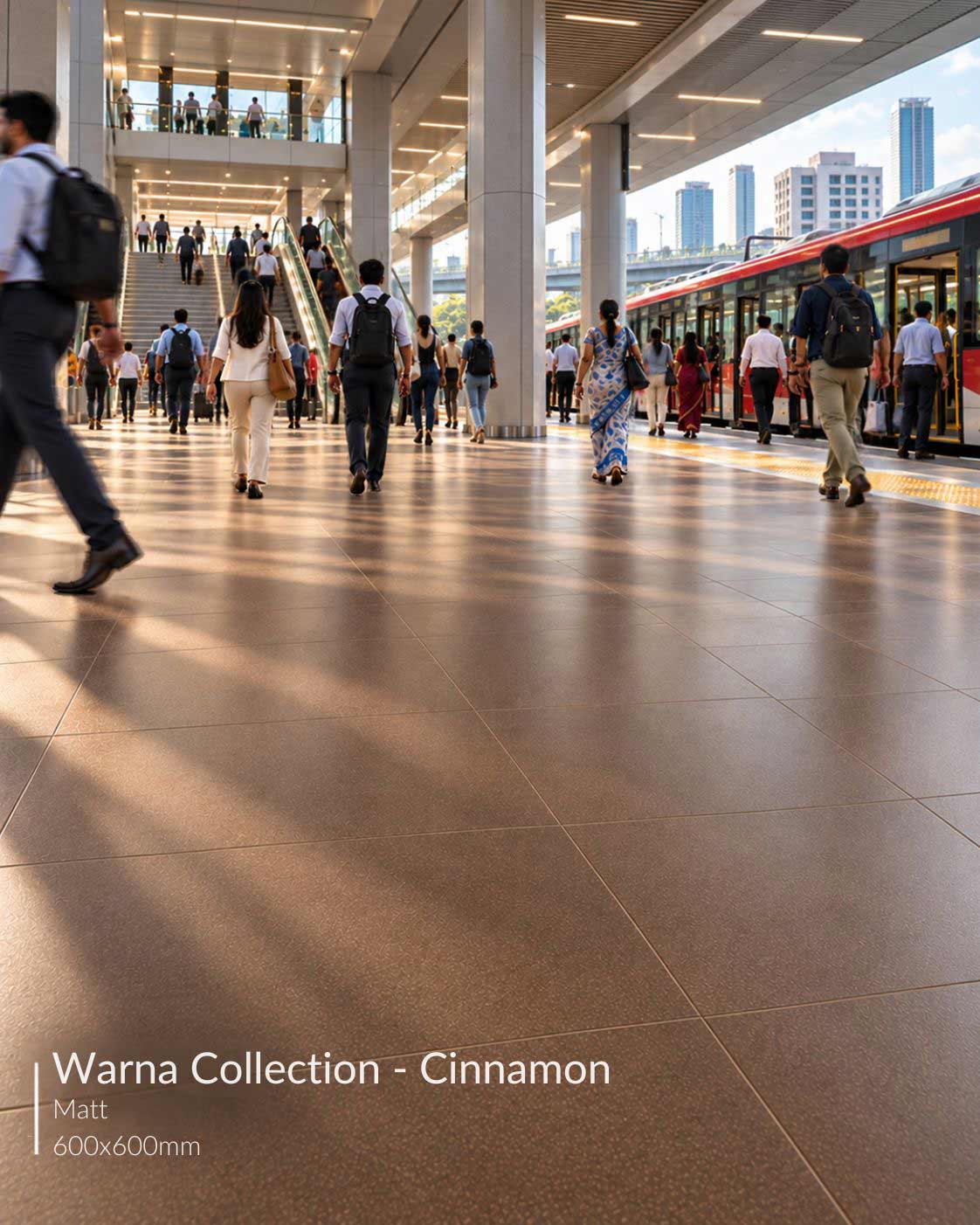
A homogeneous or full-body porcelain tile is different. Its material and colour composition continue through the tile body, creating greater visual consistency from the surface through its thickness.
Why does that matter?
Because floors in heavily used environments inevitably experience wear from sources such as:
- Shoes
- Trolleys
- Furniture
- Luggage
- Cleaning equipment
Day after day, these interactions place demands on the surface.
With a full-body construction, minor wear or an occasional chip tends to be less visually disruptive than it can be when damage exposes a contrasting body beneath a decorative top layer.
That does not make any tile indestructible.
It simply means that the construction of the tile is better aligned with environments where long-term surface appearance matters.
Homogeneous tiles are produced from refined mineral and clay-based materials that are processed, compacted and fired to create a dense porcelain body. This manufacturing approach contributes to the strength and low porosity associated with the category. For an architect or developer, these are not abstract technical qualities.
They translate into questions that matter on a real project:
How will this floor respond to constant pedestrian traffic?
How easily can the surface be maintained?
What happens in areas regularly exposed to moisture?
Will the appearance remain appropriate for the building’s intended life?
For a homeowner, the questions may be simpler but equally relevant.
What should we use in the entrance?
Will the living and dining floor handle everyday family life?
What about a home office or an area where furniture is regularly moved?
In Sri Lanka, the applications for full-body porcelain extend well beyond one category of building.
Consider the environments that experience sustained daily movement:
- shopping and retail spaces
- supermarkets
- hotel public areas
- office corridors
- restaurants
- educational institutions
- healthcare environments
- public buildings
- apartment common areas
- showrooms
- heavily used residential spaces
LANKATILES Homogeneous Full-Body Collection
LANKATILES PRODUCT SPOTLIGHT – Space to introduce the key LANKATILES Homogeneous/Full-Body Porcelain offerings selected for the article. Ideally include hero ranges suitable for different architectural and traffic requirements.
The strongest argument for homogeneous tile is ultimately quite simple.
Some floors are expected to do more.
They carry more people.
They are cleaned more often.
Furniture passes over them more frequently.
They form part of buildings designed to remain in service for years.
In those environments, the construction of the tile becomes just as important as the appearance printed or polished onto its surface.
That is why homogeneous full-body porcelain deserves to be considered not simply as another flooring category, but as a long-term architectural surface.
For LANKATILES, this thinking sits naturally within a broader approach to design: understanding the needs of the space first, then selecting the right surface solution for the way that space will actually be used.
Because a floor should do more than look right when a project opens.
It should continue to belong there as the building lives, works and welcomes people every day.
Creating spaces you’d love to live in-and spaces designed to perform for the way we live and work.